


What is Editing?
Editing is the professional, systematic process of evaluating, refining, and improving a written work so that its ideas are clear, coherent, effective, and appropriate for their intended audience, purpose, and medium. At its core, editing addresses both what is being communicated and how it is communicated, moving along a continuum from big-picture concerns—such as structure, logic, argumentation, narrative development, and scope—to fine-grained details like tone, clarity, consistency, grammar, style, formatting, and accuracy. Editing is not merely error correction; it is an interpretive and analytical act in which an editor reads as an informed, attentive surrogate for the reader, identifying gaps, ambiguities, redundancies, misalignments, and missed opportunities, and then making or recommending changes that strengthen meaning, flow, credibility, and impact. Depending on the stage and goals of a project, editing may involve diagnosing conceptual or organizational issues, reshaping paragraphs or sentences for clarity and emphasis, enforcing stylistic and disciplinary conventions, or ensuring technical precision and correctness. Throughout this process, our editing endeavors to respect your voice, intent, and ownership of the work, intervening not to replace your ideas but to help them emerge more fully, accurately, and persuasively—so the final text or body of work communicates exactly what it needs to, as effectively as possible.
We provide the full range of editing services listed on this page.
Attention: Editing is not proofreading!
Developmental Editing
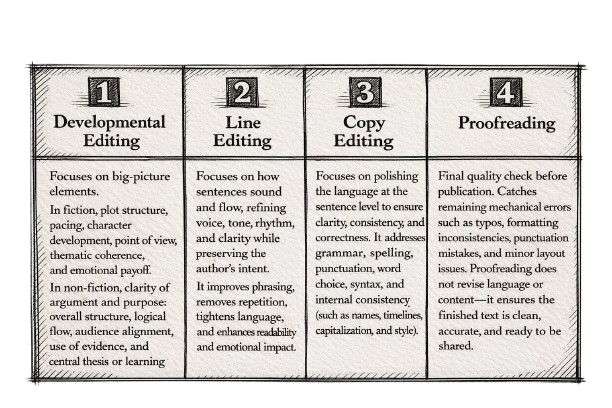
Developmental editing focuses on the big-picture architecture of a manuscript, but its priorities shift depending on whether the work is fiction or non-fiction. In fiction, developmental editing centers on narrative craft: plot structure, pacing, character development, point of view, thematic coherence, and emotional payoff. The editor looks at whether scenes earn their place, characters act with believable motivation, tension escalates effectively, and the story delivers on its promises to the reader. In non-fiction, developmental editing emphasizes clarity of argument and purpose: overall structure, logical flow, audience alignment, use of evidence, and whether each chapter advances the central thesis or learning goal. Rather than shaping suspense or character arcs, the editor helps refine the author’s voice, tighten claims, reorganize sections for impact, and ensure ideas build persuasively and accessibly. In both cases, developmental editing is collaborative and strategic—but fiction shapes experience, while non-fiction shapes understanding.
Line Editing
Line editing focuses on how sentences sound and flow, refining voice, tone, rhythm, and clarity while preserving the author’s intent. It improves phrasing, removes repetition, tightens language, and enhances readability and emotional impact. In book editing, line editing sits between developmental work and copy editing, shaping prose at the stylistic level rather than fixing surface errors.
Copy Editing
Copy editing focuses on polishing the language at the sentence level to ensure clarity, consistency, and correctness. It addresses grammar, spelling, punctuation, word choice, syntax, and internal consistency (such as names, timelines, capitalization, and style). Copy editing does not alter the author’s ideas or structure—it refines how those ideas are expressed so the text reads smoothly, professionally, and without distraction.
Substantive Editing
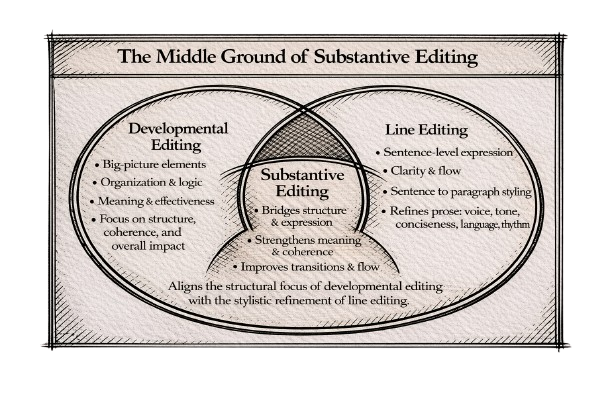
Substantive editing occupies the middle ground between developmental editing and line editing, acting as a bridge between big-picture structure and sentence-level expression. Like developmental editing, it is concerned with meaning, logic, organization, and effectiveness—examining whether ideas are fully developed, sections are well ordered, arguments or narratives are coherent, and transitions support the reader’s understanding—but it typically works within an already established overall structure rather than redesigning it from the ground up. At the same time, substantive editing overlaps with line editing because it often requires direct intervention at the paragraph and sentence level to clarify emphasis, improve flow, resolve ambiguities, or strengthen coherence; however, those sentence-level changes are made in service of content and structure rather than purely stylistic refinement. In practice, substantive editing functions as the connective tissue of the editing process: it translates developmental insights into concrete textual changes and prepares the manuscript for a more purely stylistic line edit by ensuring that what is being said is sound, complete, and logically arranged before attention turns primarily to voice, rhythm, and polish.
By its very nature, substantive editing is woven into our process. When you work with us on a developmental edit or a line edit, a degree of substantive editing naturally occurs as we address clarity, structure, emphasis, and coherence where they meaningfully affect the work. If you choose to receive both a developmental edit and a line edit with us, the substantive layer is fully and intentionally covered between those two stages—ensuring that the manuscript’s ideas are soundly structured and clearly expressed—so a separate substantive edit is not required.
Book Editing
Book editing refers specifically to editorial work on a manuscript itself and usually covers one or more defined stages—developmental editing, line editing, copy editing, or proofreading—depending on what the book needs at a given point. It is typically scoped to a single phase or pass, with clear boundaries around what the editor will address and when the work begins and ends.
Full service editing
Full-service editing is a comprehensive, end-to-end approach that supports a manuscript from early draft through publication-ready polish. In addition to multiple rounds of book editing, it often includes structural guidance, revision planning, ongoing feedback, consistency checks across drafts, author coaching, and coordination between editing stages. Full-service editing emphasizes continuity and partnership, ensuring the book evolves cohesively rather than in isolated steps.
Web Content Editing (Editorial Focus)
Web Content Editing (Editorial Focus) centers on refining website text with professional editorial judgment to ensure clarity, coherence, and consistency across all pages, while remaining distinct from UX design or technical development. This service evaluates how information is presented at the page and site level—strengthening headlines, body copy, calls to action, and supporting text so that messaging is accurate, accessible, and aligned with the organization’s voice, purpose, and audience. An editorial-focused approach addresses structure, emphasis, tone, and flow, improving readability and comprehension without redesigning interfaces or dictating user interactions. The goal is to ensure that web content communicates effectively as written content: logically organized, linguistically precise, and narratively cohesive, enabling readers to understand, trust, and engage with the site’s information with ease.
Structured Content eDITING
Structured content editing is the editorial practice of organizing, standardizing, and refining information so it functions clearly and consistently within a system rather than solely as continuous prose. This type of editing focuses on how information is broken into discrete components—such as entries, fields, categories, metadata, tags, and relationships—and how those components are defined, labeled, and aligned across a database, website, or content management system. A structured content editor applies substantive editorial judgment to ensure consistency of terminology, clarity of definitions, logical grouping, and reliable patterns in how information is presented and retrieved, often resolving redundancies, ambiguities, and structural gaps. The goal is to structure information so it can be systematically stored, retrieved, rendered, and maintained within a database.
aCADEMIC eDITING
Academic editing is a form of professional editing tailored specifically to scholarly, research-based, and institutional writing, such as journal articles, dissertations, theses, conference papers, grant proposals, and academic books. Its primary aim is to ensure that the work meets the expectations of academic audiences and gatekeepers by strengthening clarity, logic, rigor, and disciplinary conventions without altering the author’s original research or argument. Depending on scope, academic editing may include substantive elements (improving structure, argument flow, and coherence), stylistic or line-level refinement (clarifying dense prose, tightening claims, improving transitions), and copyediting (grammar, consistency, and adherence to style guides such as APA, MLA, Chicago, or journal-specific standards). A defining feature of academic editing is its sensitivity to scholarly norms—precision of language, careful qualification of claims, methodological transparency, and respect for disciplinary voice—making it less about creative polish and more about intellectual clarity, credibility, and formal compliance.
cITATION eDITING
Citation editing is a specialized editorial service focused exclusively on the accuracy, consistency, and proper formatting of in-text citations, footnotes or endnotes, and reference lists or bibliographies. Its purpose is to ensure that sources are cited correctly, completely, and in strict accordance with the required citation style (such as APA, MLA, Chicago, Harvard, or a journal’s proprietary system), and that every in-text citation has a corresponding reference entry—and vice versa. Citation editing often includes correcting formatting errors, standardizing punctuation and capitalization, verifying publication details, resolving inconsistencies, and flagging incomplete or unclear references; in more rigorous contexts, it may also involve reference checking to confirm that cited sources exist and are accurately represented. While citation editing is usually considered a subset of copyediting in academic and technical workflows, it is often treated as its own service because of its technical precision, high stakes for academic integrity, and importance for publication acceptance.